is held in Buñol, Spain. For one hour thousands of people throw tons of overripe tomatoes at each other.

This AP News image from 2025 clearly shows the goopy, messy "fun" people are having flinging smooshed tomatoes.
.
All content included on this site such as text, graphics and images is protected by U.S and international copyright law.
The compilation of all content on this site is the exclusive property of the site copyright holder.
Snyder Research Farm Tomato Tasting
Wednesday, 26 August 2026
There's something about the last Wednesday in August. It's when the traditional, extremely messy La Tomatina Festival
is held in Buñol, Spain. For one hour thousands of people throw tons of overripe tomatoes at each other.
This AP News image from 2025 clearly shows the goopy, messy "fun" people are having flinging smooshed tomatoes.
Much closer to home, definitely less messy, and also an annual event, the Snyder research and extension farm of Rutgers University hosts a traditional tomato event on the last Wednesday in August. This year, their 35th annual event, their Open House is on August 26, 2026. Attendees are invited to taste over 50 varieties of tomatoes, try new basil varieties, take a wagon tour to explore the farm’s research plots and uncover the ground breaking projects underway. There's the opportunity to meet Rutgers faculty, staff, and Master Gardener volunteers who are ready and willing to share insights and answer gardening and research questions. Register for your preferred time slot: afternoon at 1:00 - 4:00 p.m. or evening 4:00 - 7:00 p.m., $10 per person.
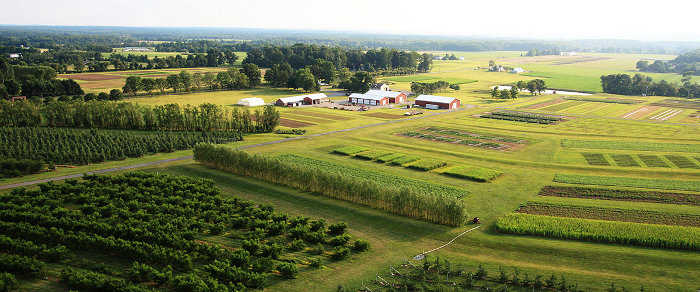
image courtesy Snyder Research Farm
The 390 acres of the Snyder Research Farm is located at 140 Locust Grove Road, Pittstown, New Jersey. The property was donated to New Jersey in 1988 through a bequest in Melda Snyder's will following her death. The focus is on sustainable agriculture, crop research, and community education. Today, 26 August 2026 they are hosting their annual open house and tomato tasting event.
My friend Bill was driving today. He parked and we walked over to the sign-in table.
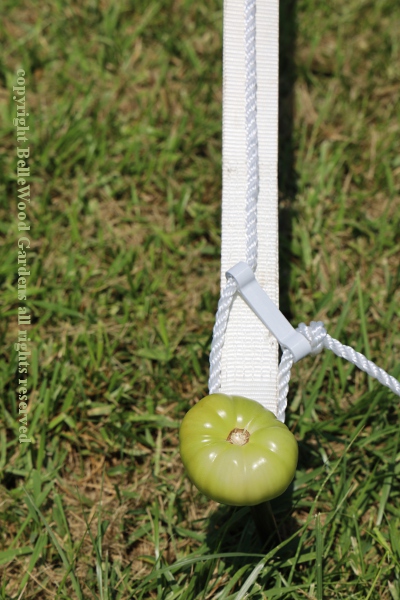
I was amused by the rather large green tomatoes impaled on the tent stakes.
Yes, playful, and also makes the metal stakes more visible to the strollers.
With 50 varieties of tomatoes for 2026 . . . that's overwhelming. I cannot taste test or even photograph that many.
First up is a tent nonchalantly sporting a sign stating, "Large Tomatoes." And they were.
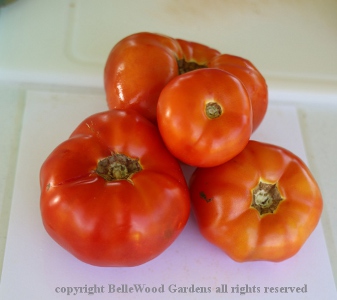 .
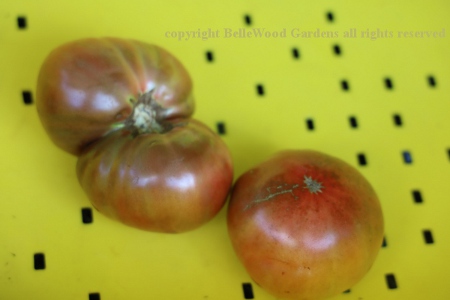
.
Glossy red classic 'Ramapo' has nostalgic "Jersey tomato" flavor with delicious balance of high sugar and high acid.
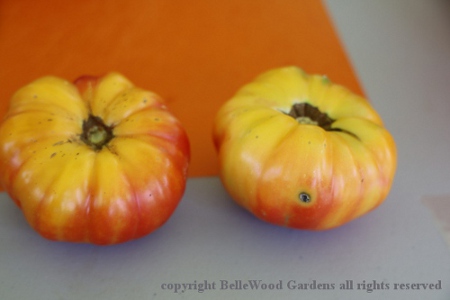
'German Chocolate' is a rare, large heirloom beefsteak variety with dark purple / chocolate color from anthocyanins.
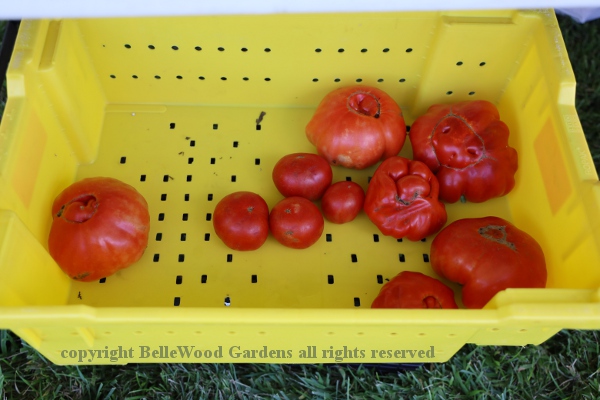
I should have asked someone to hold a 'Dinner Plate' tomato in their hand. They may be lumpy and bumpy, but also huge!
 .
.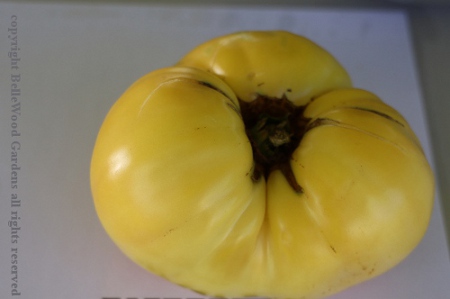
Not all tomatoes are red. Or purple. Consider the rare heirloom beefsteak tomato 'Marizol Gold' originating from
the Black Forest region of Germany. Or, allowing for some hyperbole, the low acid, sweet, mild 'White Snowball'.
.
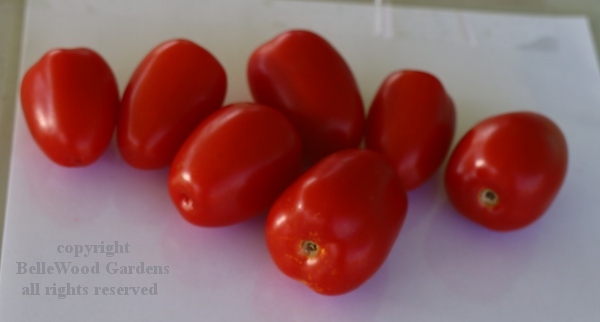
Not all tomatoes are beefsteak. There are paste / plum like these 'Tutti-Frutti Paprika' tomatoes.
I think we could have spent the rest of the afternoon wandering from tent to tent, admiring the tremendous diversity of tomatoes, sampling them, talking with the master gardeners, wandering on and sampling more tomatoes. A couple of comments: samples were handed out in little gingham patterned disposable paper food boats. With plastic forks to stab them with. I think it was intended that these be reused from booth to booth. Should have been explained. Toothpicks might be more environmentally positive than the number of plastic forks in use. And next year I think I'll bring a salt shaker with me.
There were at least three tractors, each pulling people-hauler cart. Bench down each long side and across the back. I'd guesstimate that we were probably a dozen or so but we were not squashed in close together. Paige was driving our tractor and there were two young men. One had a portable microphone. At the opposite end of the people-hauler the other man had a speaker. Our track was marked with white paint. Each planted area had a number. And the man with the microphone had printed pages from which to tell us what we were passing by. No stops. No information other than what was printed out. So questions were superfluous.
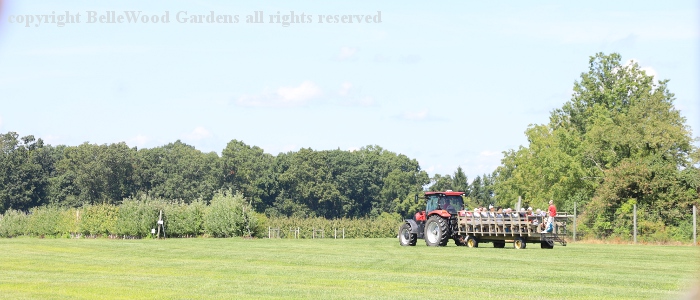
Tours are about 45 minutes to an hour long and each tour is widely spaced from any other.
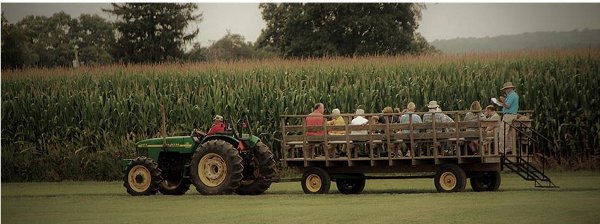
image courtesy Snyder Research Farm
We passed this row of spindle apple trees. They are planted very close together. It was not mentioned
but I happen to know they are on dwarfing rootstock. High-density production method that produces
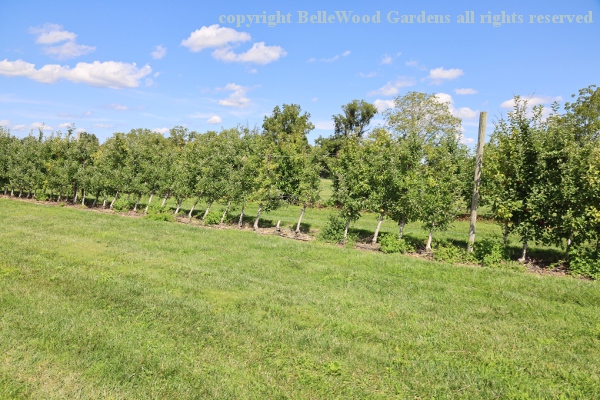
high yields of excellent quality fruit early in the orchard's life. These happen to be apples for
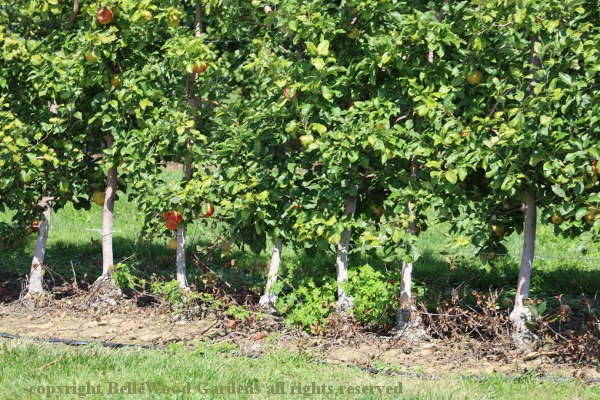
hard cider, potentially a new option for New Jersey farmers to grow and sell on to cidermakers.
An aside - Ironbound Farm and Ciderhouse in Asbury, New Jersey (where we were 10 days ago) sources their apples from family farms and orchards across New Jersey, New York, Pennsylvania, and Mid-Atlantic and New England regions.
There is a lovely amenity, A cooling tent where attendees pick up a bottle of cool water. Some simple folding chairs so you can sit and relax. And two very apropos taste treat options.
Summer tomato dishes such as ratatouille are too involved for a quick bite. So how about bruschetta? Absolutely! Tomatoes, basil, balsamic vinegar, olive oil, toasted bread. Tomato glop prepared in advance, toasted baguette chips, way to go. Actually, what we call bruschetta is really the name for the bread. With the tomato glop it should be called bruschetta al pomodoro, bruschetta with tomato.
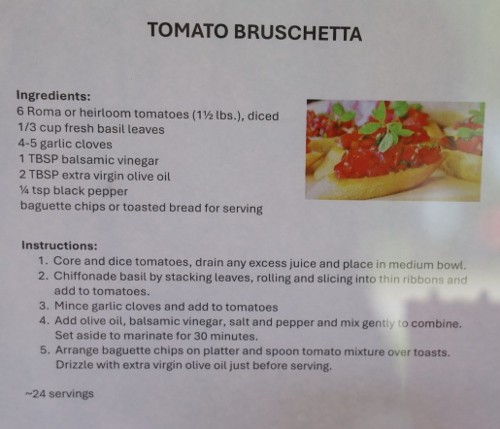
As well as this recipe poster there were simple little recipe sheets to take home.
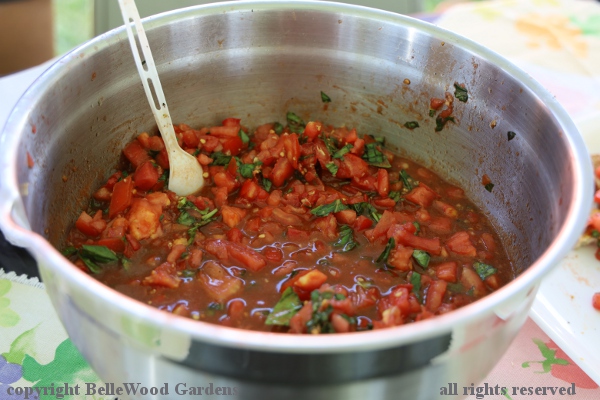
A generous pot of prepared pomodoro ready to use (and another one all ready, set aside.)
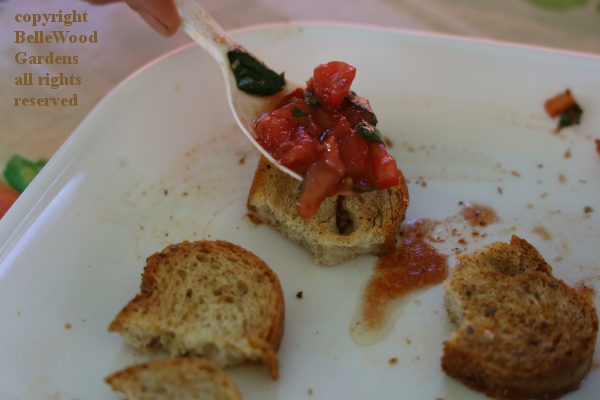
Easy peasy. Toasted baguette bread chips, spoon on a dollop of pomodoro, hand it over.
So good, I confess, that I had a second one.
Master gardener volunteers were hard at work today and before. They picked tomatoes served
at the booths, assisted with serving, and answered gardening questions from the general public.
And happily told everyone they saw that snow cones might be had at the cooling tent. Free.
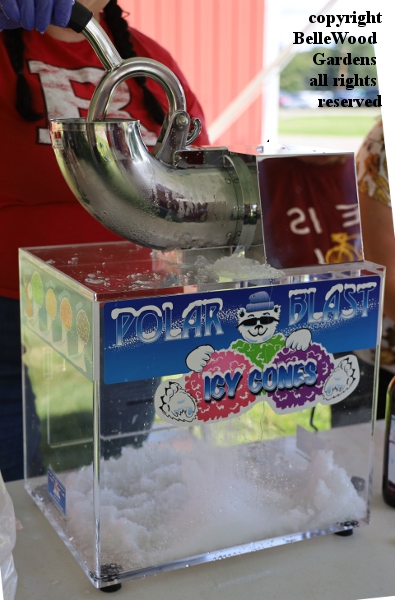
The machine makes quick work of shaving chunks of ice
into crunchy, granular coarsely crushed ice for snow cones.
Scoop it into a paper cone, add sweet syrup, ready to enjoy.
Staff on the Snyder Research and Extension Farm looks to develop potential new crops for New Jersey farmers, unique crops with potential for regional growth, such as hazelnuts and fiber hemp. And beach plums. Something to share from the tractor tour. There was a row of - let's call them trees. Short trunks and very bushy tops. "Beach plums." our guide announced. Turns out these were beach plums grafted onto cut down peach trees. Ultra-niche specialty crop research.
Of course my choice for which syrup was simple. "Beach plum syrup." I said.
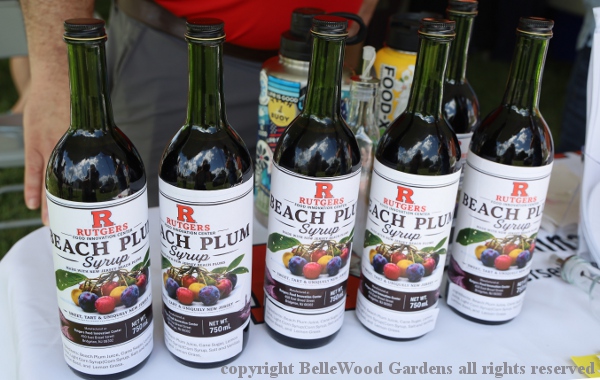
The 7 bottles are their entire first run. None for sale, alas. Modest list of ingredients begins:
with beach plum juice, cane sugar, lemon juice, light corn syrup, salt, vanilla, lemon basil and
lemon grass. Very nice! Now all that's required is to convince local farmers to grow beach plums.
Its been done before. Cultivation of both cranberries and blueberries was first developed here
in the Garden State. First with cranberries and in the 1900s with blueberries. Why not beach plums,
now that a technique for growing them away from sandy ocean beaches has been developed.
Beyond the tomato sampling tents there is a corn field, one side with a border of sunflowers.
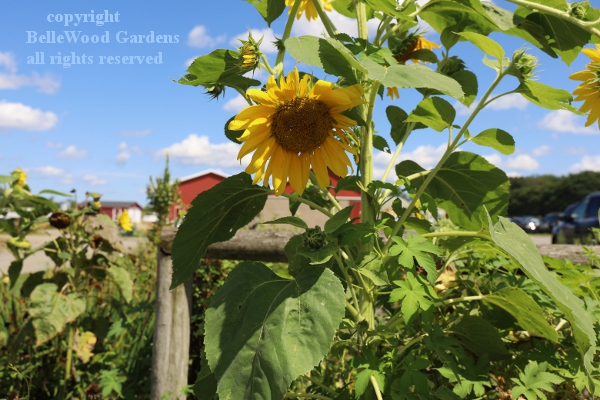
Close to the parking area there is a post-and-rail corner marking the roadway. And a sunflower
bidding us adieu to a pleasing afternoon tasting tomatoes - and more - at the Snyder Research Farm.
If you have any comments or questions, you can e-mail me: jgglatt@gmail.com
Back to August
Back to the main Diary Page